
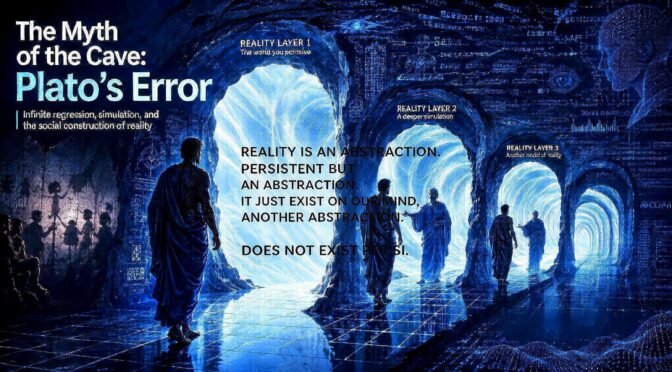
Plato’s Error: The Cave Beyond the Cave
Plato’s Error may not have been the allegory of the cave itself. His deeper error may have been assuming that, once the prisoner escapes the cave, he finally reaches reality.
But why should the first exterior be the final exterior?
What if the person who escapes one cave simply enters another?
And what if every new liberation reveals only a larger, more sophisticated cave?
This possibility changes the problem completely. Instead of asking how human beings can reach reality, perhaps we should ask whether any final reality can ever be reached at all.
The Problem with the Final Reality
Plato’s allegory remains one of the most powerful metaphors in philosophy.
The prisoners see shadows and mistake them for reality. One prisoner escapes, encounters the outside world and discovers that what seemed real was only a representation.
The traditional interpretation is clear: ignorance gives way to knowledge.
However, one assumption remains largely untouched.
The prisoner who leaves the cave is supposed to have reached a more authentic reality.
But how could he know?
The first cave may simply exist inside a second cave.
The second may exist inside a third.
And the third may be part of a much larger system of representations.
In other words, Plato successfully questioned one reality, but then stopped questioning too early.
The Cave Beyond the Cave
Imagine three stages.
Plato I describes people who believe the shadows on the wall are reality.
Plato II describes the person who leaves the cave and realizes that the shadows were representations.
Then comes Plato III.
The person who escaped now discovers that the outside world itself may also be constructed, interpreted or mediated.
There is no obvious reason why this process should stop.
Each new level of understanding may expose the previous one as incomplete.
Therefore, liberation may not lead from illusion to truth.
It may lead from one representation to another.
This creates the possibility of an infinite regress.
Do Realities Exist?
This leads to a more disturbing question.
Do realities exist independently in a form that human beings can finally possess?
Human experience is always mediated.
We perceive through biological limits. We remember selectively. We interpret through language. We organize meaning through culture. Institutions define categories. Technologies filter attention. Power determines which interpretations receive legitimacy.
Therefore, what we call reality may always contain layers of representation.
This does not necessarily mean that the material world does not exist.
It means that the humanly accessible world is never encountered without interpretation.
Matter, perception, language, memory, institutions and technology interact continuously.
As a result, what people experience as reality is never simply given.
It is produced through relationships among these elements.
Power and Permitted Realities
This problem becomes even more important in social and organizational life.
Not every interpretation has the same chance of becoming accepted.
Governments, corporations, media organizations, digital platforms, universities, legal systems and economic institutions influence which interpretations become visible, credible and legitimate.
However, this does not require a secret group controlling everything.
The system can emerge from interaction among institutions, incentives, markets, technologies, laws, algorithms and human behavior.
Power often operates by shaping the field within which interpretation becomes possible.
Some realities become socially acceptable.
Others remain marginal.
Some interpretations receive institutional support.
Others disappear.
Therefore, power does not simply impose reality.
It influences which realities are permitted to circulate, stabilize and endure.
Artificial Intelligence and the Production of Reality
Artificial intelligence makes this process more visible.
A prompt generates an image.
A different prompt generates another.
Both may appear coherent.
Both may be internally convincing.
Yet they are different representations of the same imagined object.
Something similar happens in organizations and societies.
Change the assumptions, variables, language or incentives, and a different reality can emerge.
AI therefore offers an unusually clear metaphor for the construction of meaning.
Prompts do not simply describe reality.
They help define what can appear.
In the same way, institutions, narratives, algorithms and decision systems function like social prompts.
They help shape the field of possible interpretation.
From Truth to Scenarios
If no observer can be certain that he has reached the final cave, then strategic thinking must change.
Organizations should become less dependent on the assumption that a single correct interpretation exists.
Instead, they should work with multiple plausible representations.
This does not mean abandoning evidence.
On the contrary, evidence becomes even more important.
However, evidence should be used to compare competing interpretations rather than to prematurely declare one final reality.
This is where scenario analysis becomes especially useful.
Instead of asking:
What is the reality?
leaders can ask:
What realities are plausible under different assumptions?
Then they can examine:
- what variables would make each scenario possible;
- what evidence supports or weakens each interpretation;
- what interests are involved;
- what consequences follow;
- and what signals would indicate that one scenario is becoming more relevant.
This approach is more compatible with uncertainty.
Strategic Implications for Organizations
Organizations often fail because they become trapped inside a single interpretation.
A company may believe its market is stable.
A government may assume a geopolitical relationship will continue.
A manager may believe employees support a transformation.
A board may accept financial growth as proof of strategic strength.
These interpretations can become organizational caves.
The danger is not simply that they are wrong.
The danger is that they become invisible assumptions.
Once an interpretation is institutionalized, people may stop recognizing it as an interpretation.
It becomes “the way things are.”
That is precisely when strategic vulnerability increases.
Recursive Questioning
One way to resist this problem is through recursive questioning.
Instead of accepting the first explanation, the decision-maker repeatedly asks:
What does this mean?
Then:
What does this represent?
The process continues until the analysis reaches deeper mechanisms, values, interests, identities, consequences or the point where no stronger evidence is available.
The purpose is not to discover an ultimate truth.
It is to prevent premature closure.
Each answer can reveal another layer.
Each layer may expose another cave.
This approach can be useful in strategic diagnosis, organizational change, implementation, decision-making and post-decision learning.
Plato’s Error in Management
The managerial version of Plato’s Error occurs when leaders believe they have finally discovered the real problem.
They may say:
“The problem is culture.”
“The problem is leadership.”
“The problem is technology.”
“The problem is execution.”
“The problem is resistance to change.”
But each statement may only identify one level of explanation.
What does resistance represent?
What does weak execution represent?
What does a cultural conflict represent?
What interests, incentives or identities lie beneath the visible problem?
The first explanation may be only the first cave.
Change Management and Multiple Realities
This also changes how organizational change should be understood.
Change is often treated as a technical process.
A new structure is designed.
A system is implemented.
Employees are trained.
Communication is delivered.
However, people do not react only to technical change.
They react to what the change means.
One employee may see opportunity.
Another may see loss of status.
A manager may see modernization.
Another may see a threat to authority.
The same organizational event can therefore generate multiple realities.
Successful change requires understanding these competing interpretations.
Otherwise, management may attempt to implement one reality while employees are living inside another.
The Strategic Value of Uncertainty
Uncertainty is often treated as something that should be eliminated.
But perhaps uncertainty has strategic value.
It reminds decision-makers that their interpretation may be incomplete.
A leader who believes he already possesses reality has little reason to keep questioning.
A leader who accepts uncertainty remains more attentive to weak signals, contradictions and alternative explanations.
Therefore, uncertainty can function as a form of intellectual discipline.
It keeps the organization from becoming imprisoned inside its own cave.
The Error Was Stopping Too Soon
Plato’s great contribution was to show that what appears real may be representation.
His possible error was assuming that the journey eventually ends.
Perhaps it does not.
Perhaps there is no final cave from which the philosopher emerges into unquestionable reality.
Instead, there may be successive layers of perception, interpretation, power, institutions and representation.
The practical consequence is not paralysis.
So, it is humility.
Decision-makers do not need absolute reality in order to act.
They need stronger interpretations, better evidence, alternative scenarios, and the ability to revise assumptions when the world changes.
The goal is not to escape every cave.
That may be impossible.
The goal is to recognize that we may still be inside one.
Visit the Home Page. Click here.
Affonso Henriques
PhD by ESADE Business School & Law – Barcelona – Spain