Category Archives: Strategic Insights Posts

The Devil Is in the Details: What CEOs and Boards Overlook

Details. It is often said that a company’s board of directors should focus on the big picture. Countless management books reinforce this view, emphasizing strategic oversight while portraying the CEO as the public face of the organization.

Yet this approach carries a risk: CEOs and boards may gradually drift away from the company’s heart — the operational details that reveal how the organization actually functions.

The conventional division of responsibilities seems straightforward. The macro perspective belongs to the board and CEO, while the micro perspective is delegated to middle management and those responsible for execution.

But what happens when those at the top become unfamiliar with the very organization they are supposed to lead?

There is an old saying: The devil is in the details.

A company’s heart beats not only in strategic discussions but also in its everyday management and execution. This does not diminish the importance of the macro perspective. Rather, it suggests that strategic oversight must remain connected to operational reality.

The difficulty lies in determining what that reality actually is.

Different organizational levels may perceive the same company differently. The reality presented in a boardroom may not correspond to the reality experienced on the production floor, in administrative processes, or in interactions with customers.

Effective leadership requires examining these perspectives and identifying which most accurately reflects the organization’s actual condition.

Consider something as simple as a fastener holding a product together. Is it properly positioned? Does it perform its function? Could a seemingly insignificant defect compromise the entire product?

A CEO or board member need not personally inspect every fastener. But they must ensure that the organization’s systems, reporting structures, and management practices do not conceal such details from strategic decision-making.

The same principle applies to organizational processes, internal communication, operational risks, and everyday decisions. Details!

The macro view provides direction. The micro view reveals whether that direction is grounded in reality.

Boards and CEOs who lose sight of operational details risk managing an abstract representation of their company rather than the company itself.

And that is precisely where the devil makes his home: in the details.

Affonso Henriques
PhD by ESADE Business School & Law – Barcelona – Spain.

Solution Providers

Solution providers are what professionals fundamentally are within organizations.

This may sound obvious. Perhaps it is. Yet some of the most important ideas in management become invisible precisely because they seem too obvious to repeat.

Since human beings first began organizing themselves collectively, cooperation has existed largely because certain problems could be addressed more effectively together than individually.

That logic remains unchanged.

A company solves problems for customers. A hospital addresses health-related needs. A university deals with knowledge and education. A bank handles issues involving payments, credit, investment, security, and financial organization. Public institutions respond to collective needs that individuals cannot adequately manage alone.

Therefore, regardless of title, hierarchical position, or professional specialty, one fundamental question remains:

What problem am I here to help solve?

We Sometimes Forget Why Organizations Exist

Organizations naturally become complex.

As they grow, they develop departments, procedures, budgets, reporting systems, indicators, technologies, meetings, committees, and hierarchies.

All these mechanisms may be necessary.

However, complexity creates a risk. Over time, professionals can begin to confuse organizational mechanisms with organizational purpose.

Completing a report becomes an objective.

Following a procedure becomes an objective.

Holding a meeting becomes an objective.

Achieving an internal indicator becomes an objective.

Yet none of these activities has value by itself.

Their value depends on whether they contribute to solving a problem or creating something useful for someone.

That distinction may appear simple, but it can fundamentally change how management is understood.

What Is Expected of Us?

When entering an organization, especially in a new position, people often ask:

What is expected of me here?

The formal answer usually comes from a job description.

A professional may be expected to manage a team, prepare reports, analyze data, supervise operations, develop strategies, negotiate with suppliers, serve customers, or coordinate projects.

Those are descriptions of activities.

They are not the deepest explanation of the role.

Behind them lies something simpler:

The professional is expected to help solve problems.

Managers bring problems.

Colleagues bring problems.

Customers bring problems.

Suppliers sometimes bring problems.

Society itself may confront the organization with issues requiring answers.

Professional value, therefore, cannot be reduced to completing tasks.

Tasks are means.

Solutions are the reason those tasks exist.

Colleagues Are Also Recipients of Our Work

Problem solving should not be restricted to external customers.

Inside organizations, people constantly serve one another.

A manager depends on information produced by another department.

A salesperson needs support from operations.

Operations depend on technology.

Technology depends on clear requirements.

Senior management relies on reliable analysis.

Employees rely on human resources, legal teams, finance, administration, and many other internal functions.

Organizations can therefore be understood as networks of people solving problems for other people.

An internal colleague may, in this sense, be considered a recipient of professional value.

This does not mean transforming every organizational relationship into a commercial transaction.

It means recognizing interdependence.

If someone needs our work in order to perform theirs, then our contribution is part of a solution.

Products Are Means, Not Ends

The same logic applies to products.

Organizations sometimes become so attached to what they manufacture or sell that the product itself begins to look like the final purpose.

Technical specifications improve.

Features increase.

Packaging changes.

Production becomes more efficient.

All of this can be useful.

However, a technically excellent product may still fail if it does not solve a meaningful problem.

Customers rarely want products merely because those products exist.

They want what those products make possible.

A person may not fundamentally want a financial product. The deeper need could be security.

Someone may not want transportation itself. The real need may be arriving safely and on time.

A company buying software may not fundamentally want software. It may want greater productivity, fewer errors, faster decisions, or less frustration.

Even symbolic or emotional purchases address needs.

Luxury goods may respond to identity, recognition, belonging, pleasure, status, or self-expression.

From the customer’s perspective, products do not truly exist per se.

They are instruments through which needs are addressed and problems are solved.

Things Are Created to Solve Problems

Much of what organizations create consists of physical, digital, financial, or conceptual constructions designed to address human problems.

Products, services, processes, systems, institutions, brands, contracts, and organizational structures are all created for a purpose.

None of them should become detached from the problem that justified its existence.

When that connection disappears, an organization may become extremely efficient at producing something that no longer matters enough to the people it was meant to serve.

This is why one question should remain permanently alive:

What problem does this solve?

Shareholders Do Not Simply Want Money

The same reasoning applies to shareholders.

It is common to say that shareholders want financial return.

Of course they do.

However, money itself is rarely the final objective.

Money enables something else.

It may provide security, freedom, consumption, investment, retirement, opportunity, status, influence, inheritance, or the ability to pursue other goals.

Financial value can therefore be understood as a means rather than an ultimate end.

This does not reduce the importance of profitability.

A private organization that cannot remain economically sustainable eventually loses its ability to solve problems at all.

However, profitability matters because of what it allows the organization and its stakeholders to accomplish.

That distinction is important.

Management Techniques Are Instruments

The same principle applies to management techniques.

Strategic planning is a tool.

Marketing is a tool.

Statistics is a tool.

Financial analysis is a tool.

Scenario analysis is a tool.

Organizational diagnosis is a tool.

Change management is a tool.

Technology is a tool.

None of these should become the purpose of management.

They exist because they can improve our ability to understand situations and develop better responses.

A professional may know dozens of techniques and still fail if the wrong problem is being addressed.

Conversely, someone who understands the problem deeply can usually identify which technique is actually necessary.

Therefore, technique should follow understanding.

Not the opposite.

The First Responsibility Is Understanding the Problem

If the fundamental role is to solve problems, then the first responsibility is not necessarily to provide an immediate answer.

First, we must understand what needs solving.

What is happening?

Whom does the problem affect?

Why does it matter?

What does the person actually need?

Consequences does the situation create?

What would a satisfactory solution look like?

Sometimes the problem presented is not the real problem.

A customer may complain about price when the deeper concern is uncertainty about value.

An employee may complain about workload when the underlying issue is poor prioritization.

A manager may complain about performance when the deeper problem is unclear responsibility.

For this reason, solution providers must resist the temptation to answer too quickly.

The quality of the solution depends heavily on the quality of the diagnosis.

Remembering a Basic Organizational Truth

None of this needs to be revolutionary.

That is precisely the point.

Some ideas do not need to be revolutionary.

We need to remember them.

Organizations can become so absorbed in their own complexity that professionals forget why positions, departments, systems, and techniques exist in the first place.

Organizations do not pay people merely to execute procedures.

They are not paid to execute procedures.

Employers do not hire professionals merely to maintain structures.

Ultimately, they are there because someone has a problem that requires knowledge, judgment, coordination, creativity, or action.

This applies from the most junior employee to senior management.

Thus, different positions address different problems, at different levels and with different consequences.

But the underlying logic remains the same.

Solution providers create value by understanding problems and helping to solve them.

Ask which task must be performed; perhaps the more useful question is:

What problem are we trying to solve?

That question is simple.

It is also surprisingly easy to forget.

Remember: Products do not exist per se. They exist as constructed solutions to human needs and problems.

See other posts on the Home Page

Affonso Henriques
PhD by ESADE Business School & Law – Barcelona – Spain

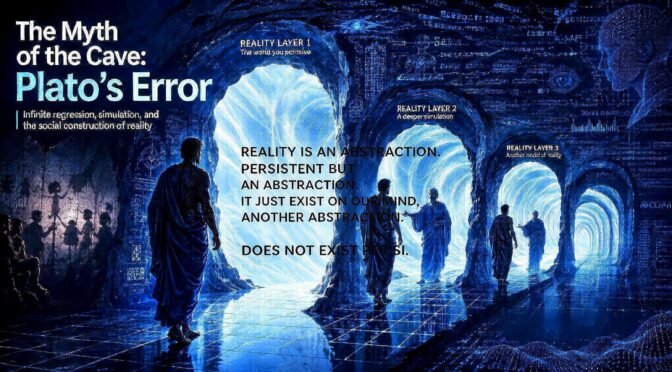
PLATO’S ERROR

Plato’s Error: The Cave Beyond the Cave

Plato’s Error may not have been the allegory of the cave itself. His deeper error may have been assuming that, once the prisoner escapes the cave, he finally reaches reality.

But why should the first exterior be the final exterior?

What if the person who escapes one cave simply enters another?

And what if every new liberation reveals only a larger, more sophisticated cave?

This possibility changes the problem completely. Instead of asking how human beings can reach reality, perhaps we should ask whether any final reality can ever be reached at all.

The Problem with the Final Reality

Plato’s allegory remains one of the most powerful metaphors in philosophy.

The prisoners see shadows and mistake them for reality. One prisoner escapes, encounters the outside world and discovers that what seemed real was only a representation.

The traditional interpretation is clear: ignorance gives way to knowledge.

However, one assumption remains largely untouched.

The prisoner who leaves the cave is supposed to have reached a more authentic reality.

But how could he know?

The first cave may simply exist inside a second cave.

The second may exist inside a third.

And the third may be part of a much larger system of representations.

In other words, Plato successfully questioned one reality, but then stopped questioning too early.

The Cave Beyond the Cave

Imagine three stages.

Plato I describes people who believe the shadows on the wall are reality.

Plato II describes the person who leaves the cave and realizes that the shadows were representations.

Then comes Plato III.

The person who escaped now discovers that the outside world itself may also be constructed, interpreted or mediated.

There is no obvious reason why this process should stop.

Each new level of understanding may expose the previous one as incomplete.

Therefore, liberation may not lead from illusion to truth.

It may lead from one representation to another.

This creates the possibility of an infinite regress.

Do Realities Exist?

This leads to a more disturbing question.

Do realities exist independently in a form that human beings can finally possess?

Human experience is always mediated.

We perceive through biological limits. We remember selectively. We interpret through language. We organize meaning through culture. Institutions define categories. Technologies filter attention. Power determines which interpretations receive legitimacy.

Therefore, what we call reality may always contain layers of representation.

This does not necessarily mean that the material world does not exist.

It means that the humanly accessible world is never encountered without interpretation.

Matter, perception, language, memory, institutions and technology interact continuously.

As a result, what people experience as reality is never simply given.

It is produced through relationships among these elements.

Power and Permitted Realities

This problem becomes even more important in social and organizational life.

Not every interpretation has the same chance of becoming accepted.

Governments, corporations, media organizations, digital platforms, universities, legal systems and economic institutions influence which interpretations become visible, credible and legitimate.

However, this does not require a secret group controlling everything.

The system can emerge from interaction among institutions, incentives, markets, technologies, laws, algorithms and human behavior.

Power often operates by shaping the field within which interpretation becomes possible.

Some realities become socially acceptable.

Others remain marginal.

Some interpretations receive institutional support.

Others disappear.

Therefore, power does not simply impose reality.

It influences which realities are permitted to circulate, stabilize and endure.

Artificial Intelligence and the Production of Reality

Artificial intelligence makes this process more visible.

A prompt generates an image.

A different prompt generates another.

Both may appear coherent.

Both may be internally convincing.

Yet they are different representations of the same imagined object.

Something similar happens in organizations and societies.

Change the assumptions, variables, language or incentives, and a different reality can emerge.

AI therefore offers an unusually clear metaphor for the construction of meaning.

Prompts do not simply describe reality.

They help define what can appear.

In the same way, institutions, narratives, algorithms and decision systems function like social prompts.

They help shape the field of possible interpretation.

From Truth to Scenarios

If no observer can be certain that he has reached the final cave, then strategic thinking must change.

Organizations should become less dependent on the assumption that a single correct interpretation exists.

Instead, they should work with multiple plausible representations.

This does not mean abandoning evidence.

On the contrary, evidence becomes even more important.

However, evidence should be used to compare competing interpretations rather than to prematurely declare one final reality.

This is where scenario analysis becomes especially useful.

Instead of asking:

What is the reality?

leaders can ask:

What realities are plausible under different assumptions?

Then they can examine:

  • what variables would make each scenario possible;
  • what evidence supports or weakens each interpretation;
  • what interests are involved;
  • what consequences follow;
  • and what signals would indicate that one scenario is becoming more relevant.

This approach is more compatible with uncertainty.

Strategic Implications for Organizations

Organizations often fail because they become trapped inside a single interpretation.

A company may believe its market is stable.

A government may assume a geopolitical relationship will continue.

A manager may believe employees support a transformation.

A board may accept financial growth as proof of strategic strength.

These interpretations can become organizational caves.

The danger is not simply that they are wrong.

The danger is that they become invisible assumptions.

Once an interpretation is institutionalized, people may stop recognizing it as an interpretation.

It becomes “the way things are.”

That is precisely when strategic vulnerability increases.

Recursive Questioning

One way to resist this problem is through recursive questioning.

Instead of accepting the first explanation, the decision-maker repeatedly asks:

What does this mean?

Then:

What does this represent?

The process continues until the analysis reaches deeper mechanisms, values, interests, identities, consequences or the point where no stronger evidence is available.

The purpose is not to discover an ultimate truth.

It is to prevent premature closure.

Each answer can reveal another layer.

Each layer may expose another cave.

This approach can be useful in strategic diagnosis, organizational change, implementation, decision-making and post-decision learning.

Plato’s Error in Management

The managerial version of Plato’s Error occurs when leaders believe they have finally discovered the real problem.

They may say:

“The problem is culture.”

“The problem is leadership.”

“The problem is technology.”

“The problem is execution.”

“The problem is resistance to change.”

But each statement may only identify one level of explanation.

What does resistance represent?

What does weak execution represent?

What does a cultural conflict represent?

What interests, incentives or identities lie beneath the visible problem?

The first explanation may be only the first cave.

Change Management and Multiple Realities

This also changes how organizational change should be understood.

Change is often treated as a technical process.

A new structure is designed.

A system is implemented.

Employees are trained.

Communication is delivered.

However, people do not react only to technical change.

They react to what the change means.

One employee may see opportunity.

Another may see loss of status.

A manager may see modernization.

Another may see a threat to authority.

The same organizational event can therefore generate multiple realities.

Successful change requires understanding these competing interpretations.

Otherwise, management may attempt to implement one reality while employees are living inside another.

The Strategic Value of Uncertainty

Uncertainty is often treated as something that should be eliminated.

But perhaps uncertainty has strategic value.

It reminds decision-makers that their interpretation may be incomplete.

A leader who believes he already possesses reality has little reason to keep questioning.

A leader who accepts uncertainty remains more attentive to weak signals, contradictions and alternative explanations.

Therefore, uncertainty can function as a form of intellectual discipline.

It keeps the organization from becoming imprisoned inside its own cave.

The Error Was Stopping Too Soon

Plato’s great contribution was to show that what appears real may be representation.

His possible error was assuming that the journey eventually ends.

Perhaps it does not.

Perhaps there is no final cave from which the philosopher emerges into unquestionable reality.

Instead, there may be successive layers of perception, interpretation, power, institutions and representation.

The practical consequence is not paralysis.

So, it is humility.

Decision-makers do not need absolute reality in order to act.

They need stronger interpretations, better evidence, alternative scenarios, and the ability to revise assumptions when the world changes.

The goal is not to escape every cave.

That may be impossible.

The goal is to recognize that we may still be inside one.

Visit the Home Page. Click here.

Affonso Henriques
PhD by ESADE Business School & Law – Barcelona – Spain

Do Realities Exist?

Uncertainty, Power, and the Construction of What We Call Reality

First, we usually assume that reality exists independently of us and that our task is to discover it.

However, what if every reality we believe we have discovered is itself only another representation?

Moreover, what if there is no final position outside all perspectives from which someone can say: this is reality as it truly is?

Therefore, the central question of this essay is not simply how reality is interpreted.

It is more fundamental:

Do realities exist at all?

Beyond the Idea of a Single Reality

Initially, many approaches assume that one reality exists, even if individuals perceive it differently.

However, this assumption itself may be questionable.

If every observer operates through language, concepts, values, interests, experience, institutions, and systems of interpretation, how could anyone reach a position completely outside those frameworks?

Consequently, what we call reality may always be mediated by representation.

Furthermore, if one representation is replaced by another, there is no guarantee that the new one is closer to a final truth.

It may simply be another representation.

Heisenberg as a Starting Point

For example, Werner Heisenberg provides an important intellectual starting point.

His uncertainty principle belongs to quantum physics and should not be mechanically transferred to society or organizations.

Nevertheless, it raises a broader philosophical problem: observation, measurement, and the framework used by the observer influence what can be known.

However, my argument goes further.

The issue is not merely that our knowledge of reality is incomplete.

The deeper question is whether a final reality can ever be reached at all.

Plato and the Problem of the Cave

Consider, for example, Plato’s Allegory of the Cave.

The prisoner leaves the cave and discovers that what appeared to be reality was only a world of shadows.

Eventually, the prisoner reaches the outside world.

Plato presents this outside world as a higher level of reality.

But why should the process stop there?

What guarantees that the world outside the cave is the final reality?

Perhaps, another Plato could appear and reveal that this supposed reality is itself another cave.

Then, another observer could reveal another level.

And another.

And another.

Consequently, the movement toward a final reality may become an infinite regress.

Every supposed exit from representation may simply lead to another representation.

From Reality to Representations

Therefore, perhaps we should stop assuming that there is one social or organizational reality waiting to be discovered.

Instead, there may be competing representations.

Some disappear.

Some remain marginal.

Some gain legitimacy.

Some become institutionalized.

And some become so deeply accepted that people stop recognizing them as representations.

They begin to call them reality.

At that point, a new question becomes necessary:

Why did this representation become real while another did not?

This is where power becomes central.

Power and the Conditions of Reality

Importantly, power does not need to create every idea, movement, identity, or interpretation.

People can organize genuinely.

Groups can resist institutions.

Movements can emerge independently.

Opposition can be authentic.

Nevertheless, becoming socially effective is another matter.

For a representation to become publicly visible, legally recognized, culturally accepted, institutionally durable, or politically relevant, it must operate within a field of possibilities.

My proposition is that this field is never neutral.

Structures of power influence what can exist publicly, what can circulate, what can be institutionalized, and what can endure.

Permission Does Not Mean Creation

Here, an important distinction must be made.

To say that a representation is permitted does not mean that elites created it.

Nor does it mean that the people involved are secretly controlled by dominant groups.

Instead, the argument concerns the conditions under which something becomes socially operative.

A movement may originate outside dominant institutions.

It may oppose them.

It may create real conflict.

Yet, if it eventually becomes publicly recognized, legally protected, institutionally represented, culturally normalized, or politically durable, then the conditions that allowed this transformation must also be examined.

The question becomes:

Who controls, influences, opens, closes, or benefits from those conditions?

What Does It Mean to “Gain Space”?

For instance, political transitions are often described by saying that new actors “gained space.”

However, this expression already contains an assumption.

Who defined the space?

Who controlled its boundaries?

Who previously prevented access?

Who possessed the capacity to repress it?

Who stopped repressing it?

Therefore, what appears to be a simple conquest of space can also be interpreted as entry into a field that became historically possible.

This does not deny struggle.

It does not deny resistance.

It changes the question.

Instead of asking only:

How did the movement gain space?

we should also ask:

Under what conditions was that space allowed to exist?

Movements, Elites and Adaptation

Similarly, dominant structures can benefit from movements they did not create.

At first, they may resist them.

Later, they may tolerate them.

Eventually, they may absorb part of them.

Then, what was initially disruptive may become incorporated into a new institutional equilibrium.

Importantly, this process does not require conspiracy.

It requires adaptation.

Consequently, a dominant order may survive not by defeating every challenge, but by allowing, absorbing, redirecting, or institutionalizing selected challenges.

In that sense, power can preserve itself by changing.

Artificial Intelligence and the Prompt

Today, artificial intelligence provides a useful metaphor.

When we generate an image with AI, we begin with a prompt.

The prompt influences:

  • what appears;
  • what disappears;
  • what receives emphasis;
  • what perspective is adopted;
  • what style dominates;
  • and what range of outputs becomes possible.

Therefore, the prompt does more than describe an image.

It establishes the field within which the image can emerge.

Who Writes the Social Prompt?

Likewise, organizations and societies operate through prompts.

Consider two questions:

“How can we reduce labour costs?”

and:

“How can we create more value with our workforce?”

The organization may be exactly the same.

However, the two prompts generate different analytical realities.

Similarly:

“Why are employees resisting change?”

creates a different reality from:

“Why has the organization failed to create conditions in which this change can work?”

Therefore, the question itself already shapes the field of possible answers.

Power May Act Before the Answer

Consequently, one of the strongest forms of power may operate before anyone provides an answer.

Power may influence the question.

It may define the vocabulary.

It may establish the categories.

It may determine which variables are measured.

It may decide what is considered reasonable.

It may define what is dismissed as impossible.

In other words, power may write the prompt.

Those who answer afterward may believe they are freely interpreting reality while remaining inside a representational field that was already structured for them.

Reality in Organizations

In organizations, this problem appears constantly.

Managers receive:

  • dashboards;
  • financial reports;
  • forecasts;
  • market research;
  • employee surveys;
  • strategic plans;
  • consultant presentations;
  • performance indicators;
  • risk assessments.

However, these instruments do not simply present reality.

They select information.

They classify it.

They compress it.

They emphasize some elements and exclude others.

Consequently, a manager does not receive reality itself.

The manager receives a representation considered sufficiently legitimate to support action.

The Importance of Recursive Questioning

For this reason, two questions become especially important:

What does it mean?

What does it represent?

Then, the first answer should not automatically be accepted.

Instead, it becomes the object of another question.

What does that mean?

What does that represent?

Subsequently, the analysis may move through assumptions, values, interests, identities, incentives, structures, consequences, and mechanisms.

The purpose is not endless questioning.

Rather, the objective is to discover when an apparent reality is actually the product of an unexamined representation.

What Becomes Socially Real?

Therefore, the distinction between what exists and what becomes socially real is crucial.

A representation becomes socially powerful when it begins to organize behaviour.

It can influence institutions.

It can shape decisions.

It can define acceptable language.

It can determine what appears legitimate.

It can establish what people are expected to believe or reject.

At that point, representation begins to function as reality.

My Central Proposition

Ultimately, my argument can be summarized as follows:

There are no independent realities that simply emerge and then confront power. What becomes socially real is conditioned by what structures of power permit to exist, circulate, institutionalize, and endure.

This does not mean that power creates everything.

It does not mean that resistance is artificial.

It does not mean that individuals and groups have no agency.

Instead, it means that agency operates within fields of possibility, and those fields are themselves shaped by power.

There May Be No Final Cave

Finally, we return to Plato.

Perhaps the deepest problem in the Allegory of the Cave is the assumption that the journey eventually ends.

The prisoner leaves one cave and reaches reality.

But why should we believe that?

Perhaps, there is always another cave.

Another observer.

Another language.

Another framework.

Another institution.

Another system of power.

Another prompt.

Therefore, the central task of strategic thinking may not be to discover an ultimate reality.

It may be to identify which representation is currently being treated as reality, understand why it became dominant, examine which power structures allow it to operate, and search for the representations that remain excluded.

Final Question

Ultimately, perhaps the most important question is no longer:

“What is reality?”

It may be:

“Do realities exist at all?”

And, if what we call reality is always mediated by representation:

“Who has the power to make one representation function as reality?”

Affonso Henriques
PhD by ESADE Business School & Law – Barcelona – Spain

Take a look at the Home Page